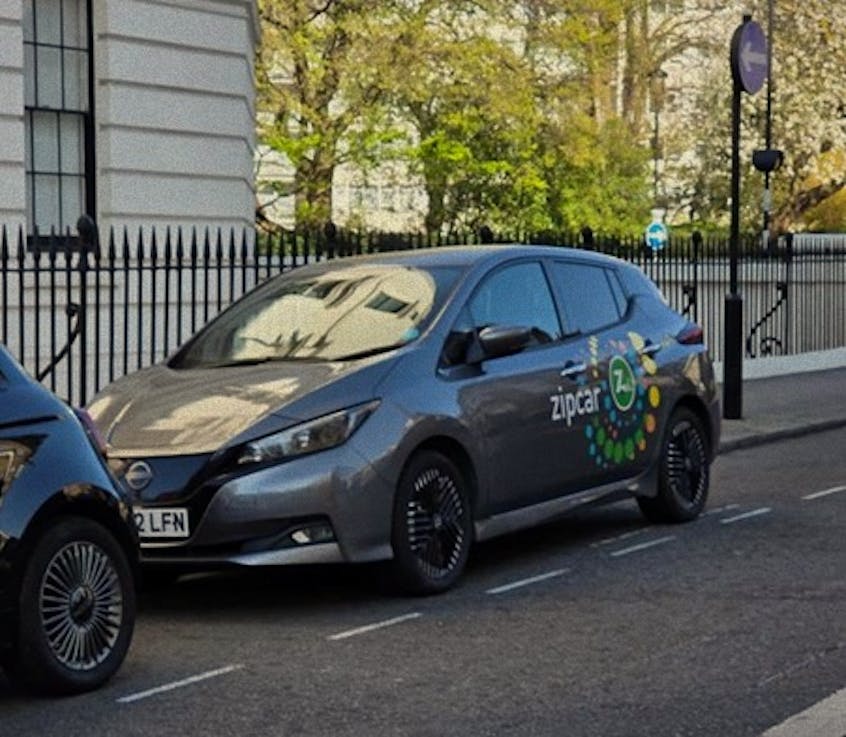
Zipcar, formerly the largest British car club, may only have represented 0.1% of London’s cars [1], but its exit from the UK shocked hundreds of thousands of customers. Its economics had been deteriorating for years. This is an opportunity to reset how London and its boroughs engage with car clubs and enable the benefits they offer – more space, cleaner air, convenient transport. This is also a moment to reflect on how more coordination across local government can help deliver other important low-carbon transport services like e-bikes and EV charging.
Car clubs have historically been treated like a private, nice-to-have service, offering parking permit revenue opportunities to councils. The service they offer is more like public infrastructure. The Mayor of London and Transport for London (TfL) could enable the remaining car clubs and other private transport infrastructure services to operate more efficiently by recognising the public benefits they offer and coordinating across local governments to bring costs down.
Car clubs offer public benefits: lower emissions, lower last-mile travel costs, more space
Car-sharing delivers on the city’s environmental and cost-of-living goals. Zipcars in particular had lower carbon emissions than the average London car. One third of its fleet was electric against a city-wide average of 6.8% [2]. Car sharing fills a transit gap between public transport and ride-hailing, like moving house, one-off trips to visit relatives, or transporting bulky goods for work. This enables residents who rarely use cars to give them up entirely, saving on annual registration and insurance fees.
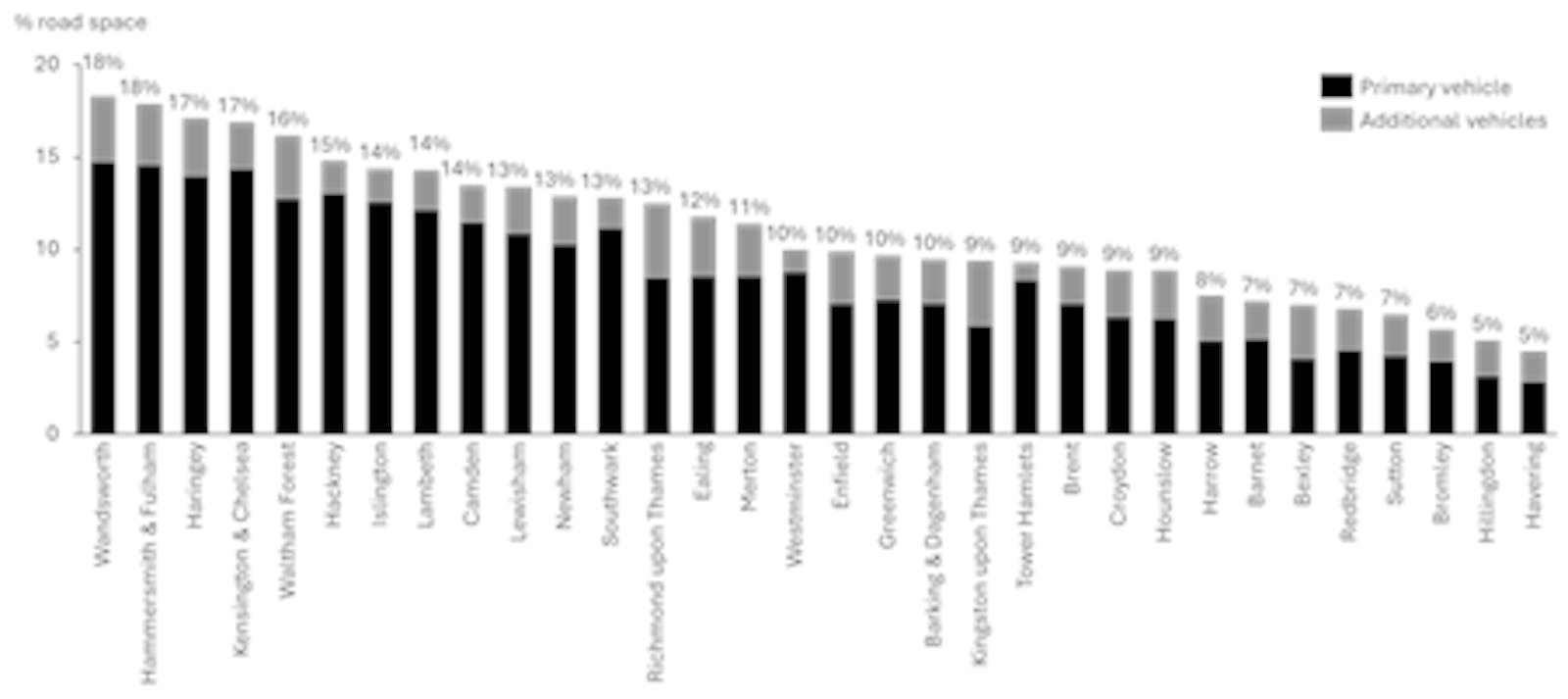
The bigger, under-rated prize is space. London has 2.6 million cars and 43% of them are parked on the street [3]. Parking takes up between 5% and 18% of all road space [4]. By another calculation, street parking uses the equivalent of 1,300 hectares of public land, or nine Hyde Parks [5].
Analysis by Collaborative Mobility UK, a charity, suggests that each car-share in London pushes at least 16 privately owned cars off the road [6]. Each shared car could save over 150 m2 in parking space [7], roughly equivalent to the internal area of three new 1-bedroom flats. In addition to decreasing congestion on the roads, councils could use this extra room to expand pavements and bike lanes, provide more parking spots for dockless e-bikes or even create space for new homes and businesses.
Zipcar’s costs went up, some driven by policy decisions
Despite all these public benefits, privately-owned Zipcar struggled with costs. It posted a loss of ~£6 million in 2024, driven by a mix of falling revenues and rising expenses [8]. Some of this was because of Zipcar’s business model. Their prices included fuel, and costs went up. Public charging is notoriously more expensive than charging at home, and Zipcar reimbursed expenses. Its convenient one-way flex journeys also raised costs as staff had to manage re-charging. Customers could leave cars on empty, possibly reducing utilisation.
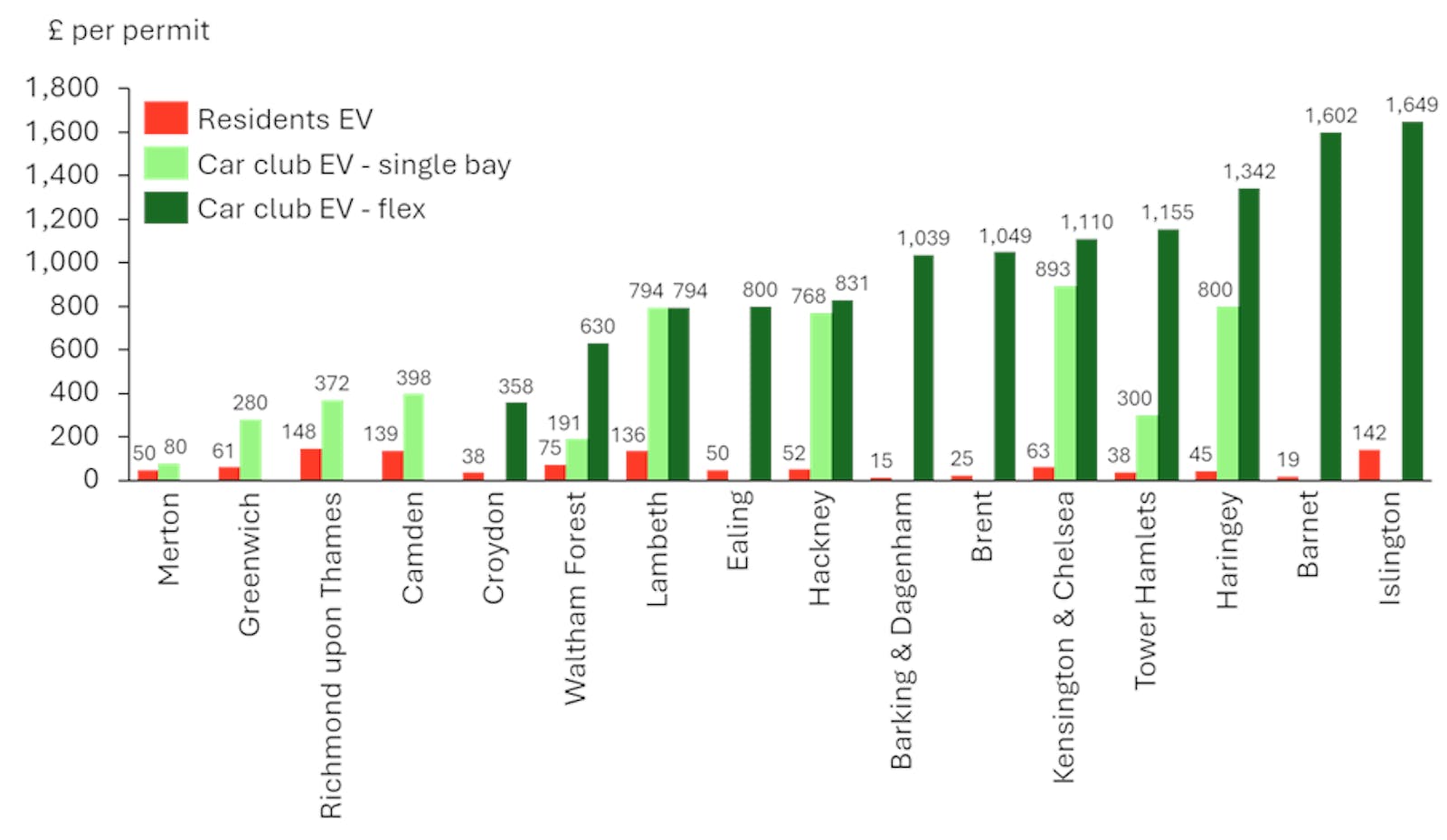
Local government fees also added costs. Zipcar negotiated parking with each of London’s 32 boroughs. Although car clubs are used by residents, councils charged them higher parking fees than resident permits for equivalent cars, especially on the flexible parking model that customers like.
While resident permits for EVs range from £15 to £150 per year, EVs in car clubs are often hit with fees that are 6 to 80 times higher, up to £1,600 for flexible parking. Haringey council even conducted a benchmarking study in 2025 to make sure they were charging similar rates to other councils, almost doubling flex parking and more than tripling fixed-bay costs.
Changes to city-wide and national policy were set to increase Zipcar’s costs further. EVs are now covered by London’s congestion charge from 2026 if trips end outside the congestion zone, now experience higher registration costs, and new mileage taxes starting in 2028.
Against this backdrop, Zipcar decided to close down, leaving hundreds of thousands of customers without their flexible car option.
Clubs should be recognised as an infrastructure asset for London
To realise the benefits of car sharing, the Mayor and the Greater London Authority could start by negotiating a framework agreement for parking fees across all London boroughs. For example, Southwark Council offered to waive £350,000 of annual fees in a last-minute bid to entice Zipcar to stay. Offering this London-wide would have been more impactful, along with a consistent approach to parking permits.
Car clubs are an infrastructure-like asset and deliver public benefits, so this should be reflected in their parking fees. If councils are worried about giving a private company too much public benefit, they could tie fee waivers to social objectives like targeting under-served locations or a high share of EVs. TfL could link the support of car clubs to increased investment in transport infrastructure as more space becomes available from fewer cars parked on the road.
London government could also help lower costs with better integration into the London transport network. They could support data sharing with car clubs to help plan investments across the system and connectivity with other services. They could even waive congestion charges for EVs in car clubs at no great cost. TfL could offer their land for car club parking and charging, and the city could invest more in charging infrastructure for car clubs alongside private investors.
The potential for coordination to reduce costs and improve services extends beyond just car clubs. A consistent approach to e-bike parking would create more buy-in, helping to alleviate transport constraints, reduce transport emissions and promote healthier commutes. This could include offering dedicated parking bays and clear policies on pavement parking, consistent and reasonable parking costs, and fines for non-compliance. London-wide agreements for EV charging that simplify their connection processes and hold operators accountable for up-time would enable more customers to trust that their local chargers work and increase EV uptake. This would lower bills and improve air quality.
A patchwork system of charges and rules prevent car clubs from realising the full potential of the public good they offer. More coordination across local governments to support car clubs, e-bikes, EV charging and more could help cut congestion, improve air quality, free up land, and help save on bills. Zipcar’s demise could be a chance for local governments in London and elsewhere to reset how they think about private distributed transport services as essential infrastructure.
References
[1] 3,000 cars in Zipcar fleet out of 2.6 million cars in London
[2] June 2024 data, Transport for London
[3] Travel in London 2017 data, the latest available that provides car parking details by borough
[4] As above. No public data is available after 2017, this trend may have changed.
[5] 43% x 2.6 million cars x 11.52m2 = 1,305 Ha, divided by 140 Ha area of Hyde Park. Previous estimates of 10 Hyde Parks by Centre for London were likely based on slightly higher car numbers and rounded space requirements from 11.52m2 (2.4m x 4.8m) up to 12m2.
[6] 31 cars per car-share if including avoided purchases of new cars.
[7] 12 m2 parking space per car. A 2022 study by CoMoUK suggests car clubs at scale (fleet of 21,000) could take 300,000 cars off the road. 300,000 fewer cars divided by 21,000 car shares = net 13.3 fewer cars per share-car after taking into account the share-car parking space. 13.3 x 12 = ~150 m2. There would be even higher space savings if a shared car takes 16 cars off the road as later data suggests.
[8] Revenues declining by £4.1 million and costs rising by £1.6 million.