The UK and the rest of the world are facing increasingly severe and frequent impacts from a changing climate. To manage these increasing risks, we will need to adapt our infrastructure, behaviour, and natural environment. Many of these adaptations will require investments in new technologies and services, such as coastal and river defences, water conservation, and early warning systems. The Climate Change Committee’s Well-Adapted UK report sets out an estimated £11 billion annual investment requirement for a UK resilient to a changing climate. Globally, the demand for adaptation technologies and services is estimated to reach $0.5 to $1.3 trillion annually by 2030, as all countries are required to adapt.
Most political debate on climate action focuses on cutting emissions. This is essential as the only way to slow the rate of global warming, but it is also critical that we adapt to the climate changes that are already locked in. This is where an interesting story emerges: the UK is exceptionally well-positioned to lead in developing the technologies and services required to protect domestic and international communities from the impacts of climate change, yet we have yet to fully capitalise on this competitive edge.
New research from the London School of Economics and Imperial College London—the most comprehensive analysis of the UK’s adaptation innovation to date—reveals that the UK ranks second in the world for specialisation in climate adaptation technologies.
Furthermore, for specific sub-sectors of adaptation technologies:
- The UK ranks fifth globally in engineering technologies required for adaptation (including adaptation at coastal zones, in water systems, and in infrastructure).
- The UK ranks second globally in life science technologies required for adaptation (including in agriculture and health, such as drought-resilient crops and vaccines against vector-borne diseases).
- The UK ranks third globally in ‘indirect’ adaptation technologies (including weather forecasting, climate simulation, assessing water resources, and monitoring invasive species).
Revealed technological advantage in all adaptation categories — top 12 countries (2000-2022)
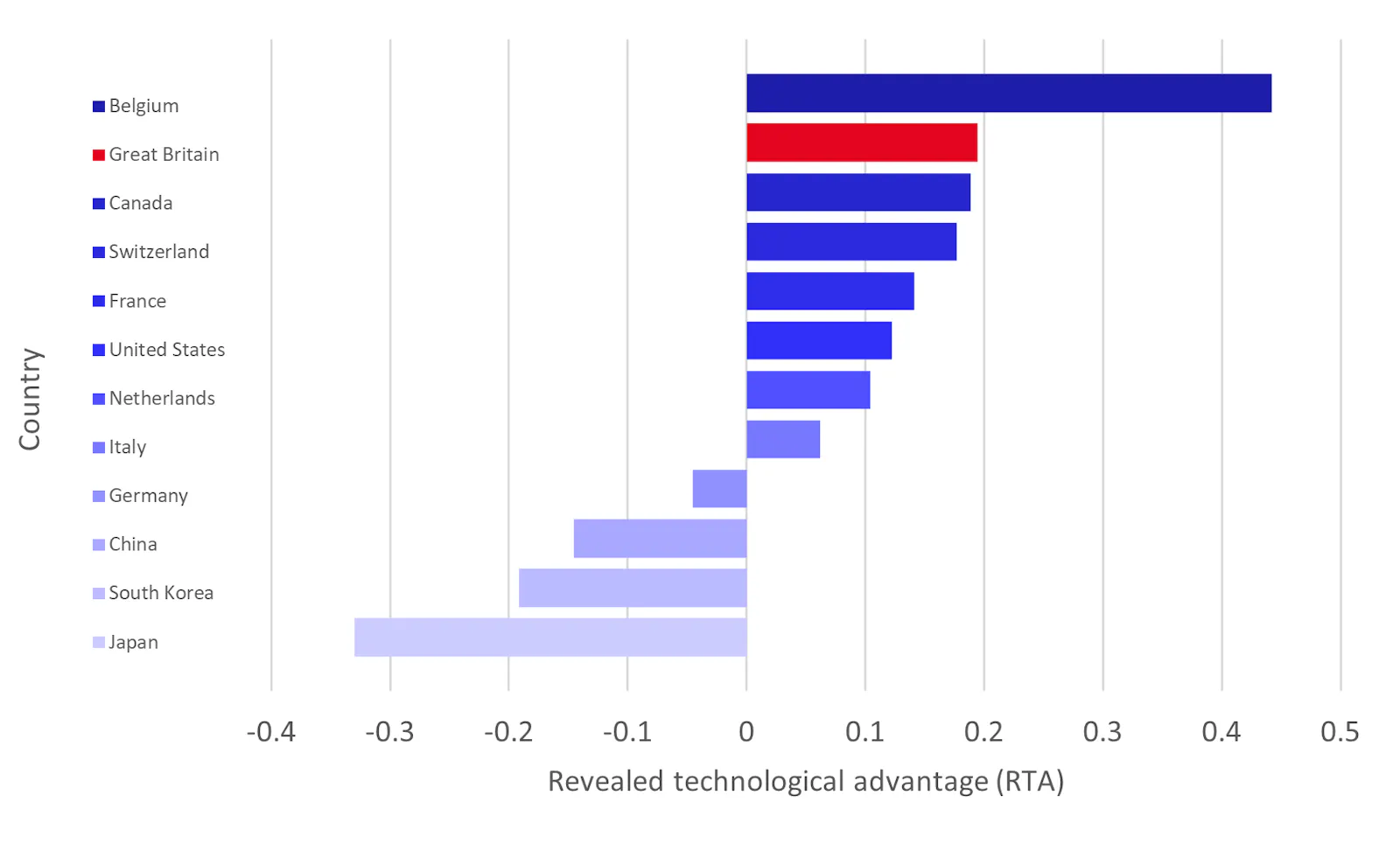
Behind these rankings are hundreds of firms across the UK, with relatively high concentrations in coastal areas, that are active in developing solutions to a rapidly changing climate. This provides a strong case for place-based industrial policy, connecting resilience investment with regional growth.
Beyond technologies, the UK also has existing strengths in the services that will see increasing demand as the climate changes, including professional and business services, insurance and financial service activities. Specifically, these services include engineering consultancy, environmental advisory and climate risk management. The UK is therefore well placed to meet growing demand as regulatory requirements, infrastructure investment cycles and corporate demand for adaptation advisory services expand. However, policy support will be needed to translate these strengths into adaptation-specific products and instruments.
And yet, we also find that the UK's adaptation economy remains relatively small, at most around a third of the size of the net zero economy. Similarly, investment flowing into adaptation technologies and services is a fraction of what goes into decarbonisation.
The government has an industrial strategy that explicitly covers the right sectors for adaptation, including life sciences, financial services, digital and technologies, and advanced manufacturing. To drive investment into adaptation, the government should join the dots to highlight climate adaptation as a key aspect of resilience in the UK’s Modern Industrial Strategy. This could help drive support for the innovation and skills required to realise the opportunities from this growing market.
With greater political ambition, the UK can become a leader in protecting communities vulnerable to the impacts of climate change both domestically and internationally, while also capturing economic opportunities from rapidly growing global markets.