Today is A-level results day – a milestone for hundreds of thousands of young people and the families that supported them. This year, exam candidates faced an extra burden: two record-breaking heatwaves. Temperatures hit 35°C in late May, while June brought record highs for three consecutive days.
Heat is already harming attainment
The Climate Change Committee's (CCC) Well Adapted UK report concludes that pupils sitting exams at 32°C are around 10% less likely to pass them than those sitting tests at 22°C. [1] The Department for Education's (DfE) own analysis estimates schools already lose 6.7 learning days a year to heat - rising to 8.2 days by 2050 without adaptation. [2]
This is happening now – and our school buildings are actively making the situation worse [3]. Let’s Go Zero is the campaign for all schools, colleges and nurseries to be zero carbon and climate resilient. Our ’Too Hot to Learn' survey of 295 schools this summer confirms the scale of the problem, with classrooms regularly exceeding 34°C. One nursery hit 42°C. "Impossible to learn. Impossible to teach," wrote one London headteacher. Our survey also asked schools what prevented them acting on the problem. 86% cited cost as their main barrier, nearly half identified their buildings. As one headteacher told us: 'The government needs to fund changes to infrastructure to ensure schools can remain open and children can learn effectively.'
A national mission – and the urgency to match
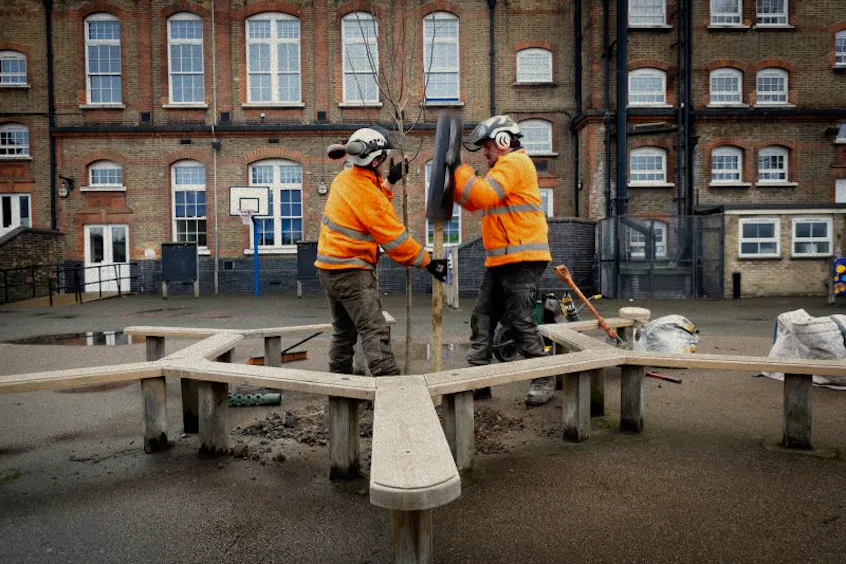
Let’s Go Zero’s Climate Action Advisors give schools free, tailored support - include help to tackle overheating. For example, an advisor supported Newham’s Central Park Primary - where playground tarmac was reaching 40°C - to plant trees, apply solar film, and create a heatwave policy. This cut ground temperatures by up to 8°C. [4] Another Let’s Go Zero School, Ark Tindal Primary Academy in Birmingham, stayed open through last month's record-breaking heatwave using a shade sail canopy and wooded growing area., where students measured temperatures almost 9°C cooler in the shade. [5] Embracing these solutions does much more than protect staff and student health. This year, independent UCL research found that climate action in schools generates "a wide and interconnected set of benefits - positive impacts for students, staff, families, nature and local communities" - with 89% reporting more comfortable and engaging learning environments. [6]
It’s vital that schools are supported to take quick, low-cost or free measures to tackle overheating. But government must also support more substantial work on school buildings, or health and learning will continue to suffer. This includes ‘retrofitting’ existing structures to address overheating.
Doing so can boost economies as well as learning. New procurement rules applying from 2027 will require school retrofit contracts to include skills, work experience and career pathways alongside the physical work. [7] Creating routes into the green economy in communities that need them most - the "prosperity in every postcode" the Prime Minister has promised to deliver.
DfE's Renewal and Retrofit Programme - £710m piloting in three regions before national rollout from 2027 – is welcome, but it is a fraction of what is needed. The gap between the urgency of the problem and the resource currently committed to it is stark. [8]
All parties should commit to three things:
- Treat adaptation as a national priority alongside net zero, backed by the CCC’s £11bn annual investment figure and statutory targets.
- Ring-fence adaptation within the Renewal and Retrofit Programme, prioritising climate-vulnerable areas and schools serving deprived communities and SEND pupils - and require every retrofit contract to deliver green skills and employment pathways.
- Give every school the practical tools and funding to act now, with accessible small grants, clear heatwave protocols, and guidance on passive, nature-based and mechanical cooling.
When today's students open their results, some of the gap between what they hoped for and what they achieved may reflect conditions beyond their control. Protecting children's life chances from a climate crisis they did not cause is not a green ask. It is a matter of basic fairness.
References
[1] Climate Change Committee, A Well-Adapted UK (2026): https://www.theccc.org.uk/publication/a-well-adapted-uk/
[2] Department for Education, Impact of UK climate change risk on the delivery of education (2025): https://www.gov.uk/government/publications/impact-of-uk-climate-change-risk-on-the-delivery-of-education
[3] Harry Paticas, 'Tarmac playgrounds and windows that don't open: why hot spells turn UK schools into heat traps', The Guardian (25 June 2026): https://www.theguardian.com/commentisfree/2026/jun/25/uk-schools-heat-traps-hot-weather-climate-crisis
[4] Let's Go Zero, Mitigating urban overheating in schools - Central Park Primary: https://letsgozero.org/overheating-in-schools/
[5] Local Storytelling Exchange / Birmingham Live, 'Birmingham school confirms major change to school days after UK heatwaves' (2026): https://www.birminghammail.co.uk/news/midlands-news/birmingham-school-confirms-major-change-34294659
[6] Ashden/Let's Go Zero, The Co-Benefits of Climate Action in Schools (UCL, 2026): https://letsgozero.org/wp-content/uploads/2026/06/Ashden-The-Co-Benefits-of-Climate-Action-in-Schools.pdf
[7] PPN 026: The Social Value Model (August 2026): https://assets.publishing.service.gov.uk/media/6a727128332792bd88ece51b/PPN_026_The_Social_Value_Model.pdf
[8] The Guardian, 'Just 20 of 6,600 Defra staff working on climate adaptation amid drought and wildfires' (12 August 2026): https://www.theguardian.com/environment/2026/aug/12/just-20-of-6600-defra-staff-working-on-climate-adaptation-amid-drought-and-wildfires


