WHAT NEXT?
The Future Homes Standard is an important and overdue step. But the built environment’s climate impact goes well beyond the emissions that come from heating and lighting our homes. The scale of addressing this challenge demands more.
By the early 2040s, the UK will need to have reduced emissions by close to 90% to keep with carbon budgets set out by the Climate Change Committee [1]. At the same time, climate impacts will be more severe, and the demands on our housing stock greater than ever. The homes we build now will still be standing in 2100 and beyond, so we need to ensure the next iteration of building regulations considers future householders - our children and our children’s children – and that regulations deliver homes which perform as promised, make smart use of resources, support nature recovery, and are resilient to a changing climate.
BUILDING WITH RESOURCES IN MIND
Perhaps the most significant gap in current regulation is “embodied carbon”: the amount of carbon that has been emitted creating the raw building materials needed. While operational emissions from buildings are beginning to fall, these emissions associated with materials and construction remain largely unaddressed.
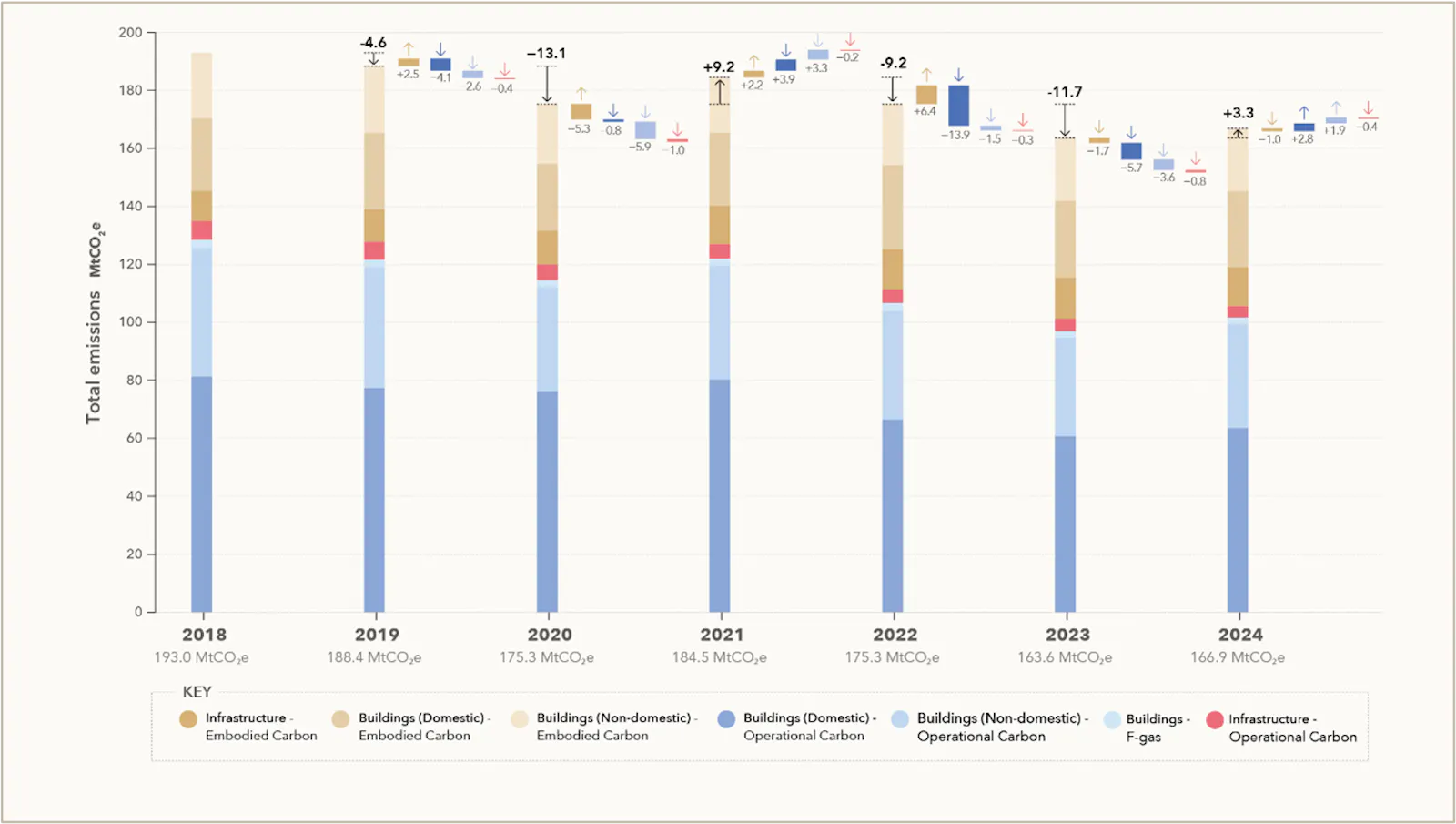
Embodied carbon already accounts for around a fifth of the UK’s built environment emissions, equating to just over 60 million tonnes of carbon in 2024 [1], and yet it remains completely unregulated. Recent UKGBC analysis suggests that emissions from domestic buildings have risen in recent years, at a time when they should have been falling sharply (see Figure 1 below) [2].
HOMES FIT FOR A CHANGING CLIMATE
Across the UK, the impacts of climate change are no longer distant projections - overheating, flooding and extreme weather are already affecting homes and communities.
In England alone, around one in four homes is at risk of flooding today. Without action, these risks will only intensify.
Source: Environment Agency (2024), National assessment of flood and coastal erosion risk in England 2024:
The Future Homes Standard includes some welcome, if limited, progress on overheating. But for it to be considered truly ‘future’ a more comprehensive approach to resilience is needed - one that integrates future climate expectations, not historical data, and ensures homes stay cool in summer, are protected from flooding, and use water efficiently.
Homes should be places of safety and many will need to be adapted to ensure they remain so. Building regulations and design must also adapt as climate risks grow to ensure the homes built today are prepared for the climate of tomorrow.
SYSTEM SUPPORT: NATURAL AND ELECTRIC
There are also wider opportunities that future standards should seize. The built environment plays a major role in biodiversity loss. Whilst policies like Biodiversity Net Gain are a step forward, there is scope to go further by embedding nature into the design of new developments so that they actively contribute to ecosystem recovery [5].
And as the new energy system evolves, homes themselves can become a key support for a grid powered by renewables with smarter energy use, greater flexibility, and demand-side response fully integrated. Discussions of future building regulations must begin to reflect this. Enabling homes to interact intelligently with the wider energy system will be vital for continued energy security and grid resilience.
This must be the future direction of building standards – this will be a key part of a transition which can deliver healthier homes, lower bills, new jobs, and a more secure energy system, all while positioning the UK as a leader in sustainable construction.
The Future Homes Standard sets a good direction, but now we need to keep moving.
References
[1] Climate Change Committee (2025), The Seventh Carbon Budget: https://www.theccc.org.uk/publication/the-seventh-carbon-budget/#publication-downloads
[2] UK Green Building Council (2026), Whole Life Carbon Progress Report: https://ukgbc.org/resources/whole-life-carbon-progress-report-2025/
[3] UK Green Building Council (2026), Whole Life Carbon Progress Report: https://ukgbc.org/resources/whole-life-carbon-progress-report-2025/
[4] Shifting Paradigms (2023), Embodied carbon reduction in EU construction makes economic sense: https://shiftingparadigms.nl/projects/eu_embodiedc/
[5] Environment Agency (2024), National assessment of flood and coastal erosion risk in England 2024: https://www.gov.uk/government/publications/national-assessment-of-flood-and-coastal-erosion-risk-in-england-2024/national-assessment-of-flood-and-coastal-erosion-risk-in-england-2024
[6] UK Green Building Council (2026), Framework for a Nature-Positive Built Environment: https://ukgbc.org/resources/framework-for-a-nature-positive-built-environment/